Chemical Data Management, Analytics & Integration Services
Chemical data management is where most programs fail: the data exists, but in five systems that never meet. Embark aggregates chemical, production, lab and telemetry data from any source into one model and delivers it in the BI platform you already use.
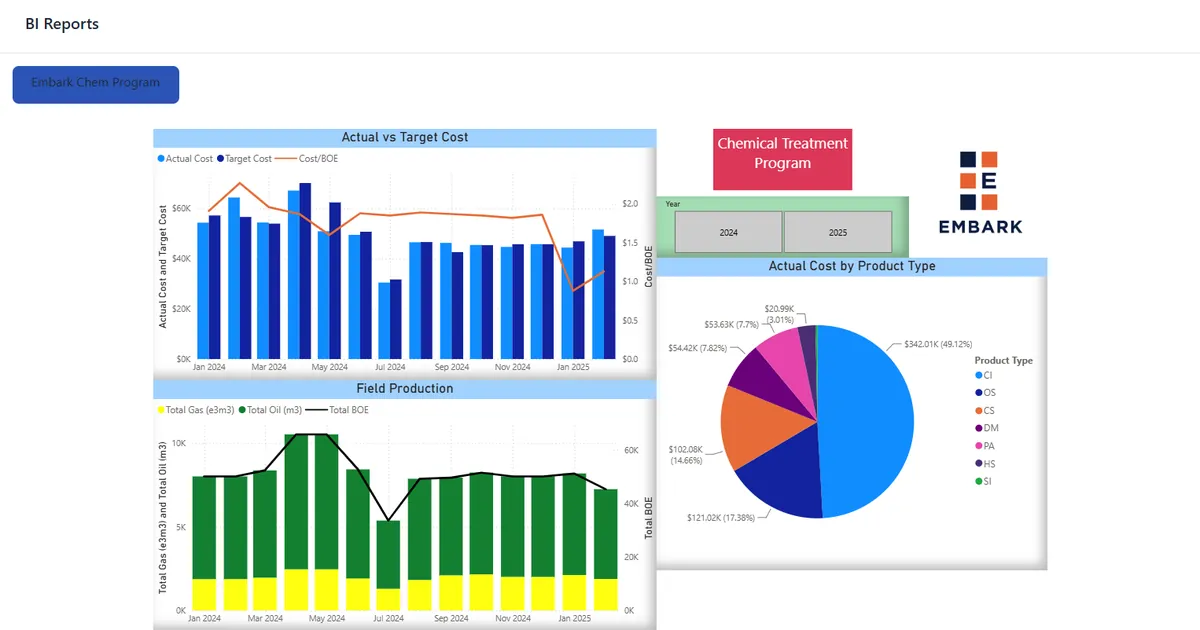
What chemical data management involves
A production chemical program generates data in the field (pump rates, tank levels, tickets), in the lab (water, bacteria, corrosion, residuals), in production accounting (oil, gas and water volumes) and in telemetry (continuous rates and levels). Chemical data management is the discipline of bringing those into one validated model with common identifiers for wells, sites and injection points, so that a PPM calculation uses yesterday’s production and last week’s pump read, not last quarter’s average.
Prodesy provides the model. Embark’s analytics and integration service does the connecting: mapping wells to treatment sites, transforming accounting exports, integrating SCADA historians and building the dashboards that make the result usable.
Results from integrated data
Integration services
- Production data integration. Accounting exports and SCADA historians mapped to injection points with automated allocation. How it works.
- Telemetry integration. Tank monitors, pump controllers and SCADA from any manufacturer. Details.
- Lab data integration. Internal and third-party lab results ingested into the analysis workflow.
- BI delivery. Embedded Power BI as standard; Spotfire, Looker Studio and corporate data warehouses through the API. Dashboards.
- Historical data migration. Years of spreadsheets and vendor reports normalized into the Prodesy model so trends start on day one.
The people behind the integration
Embark’s team has built oilfield telemetry, production databases used across the Western Canadian Sedimentary Basin and mobile field applications deployed at thousands of sites. That is the expertise applied to every integration, which is why mapping a producer’s well list to a vendor’s treatment sites is a week of work, not a quarter.
Frequently asked questions
What data sources can Embark integrate?
Production accounting systems, SCADA historians, tank and pump telemetry from any manufacturer, internal and third-party lab systems, vendor spreadsheets and Prodesy Mobile field capture.
Do we have to use Power BI?
No. Embedded Power BI is included, but the same model is delivered to Spotfire, Looker Studio or a corporate data warehouse through the API.
How is chemical data management different from a data warehouse project?
The model is already built for chemical programs: wells, injection points, products, targets, lab tests and production allocation are first-class entities. Integration is configuration and mapping, not a schema design project.
Can you integrate data for a program not using Prodesy?
Analytics and integration are delivered on the Prodesy model. Programs typically adopt Prodesy for the data layer and use their existing BI on top.
See your chemical program in Prodesy
A 30-minute online demo using your injection points, vendors and lab data. You leave knowing where variance and cost are hiding.
Book a demo