Chemical Cost per BOE: How to Measure and Reduce Oilfield Chemical Spend
Chemical cost per BOE is the number that makes a chemical program comparable across wells, vendors, months and assets. This guide shows how to calculate it correctly and the five levers that move it without compromising integrity.
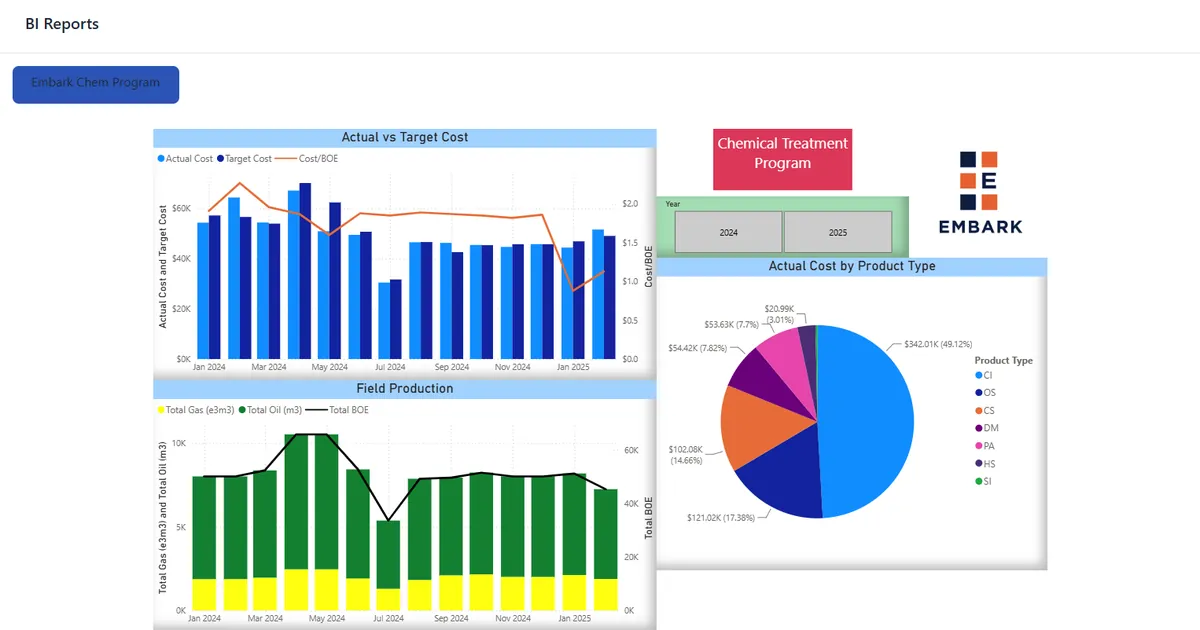
The calculation
Chemical cost per BOE = chemical cost for the period ÷ barrels of oil equivalent produced by the treated wells in the period. The denominator is the trap: it must be the production of the wells actually treated by that chemical, not the field total. A corrosion inhibitor injected at a group line is allocated to the wells behind it; a demulsifier at a battery is allocated to everything through it. Prodesy’s production data integration does this allocation automatically.
Useful variants
- Cost per BOE by product type (CI, SI, PA, DM, HS, OS): where the money goes.
- Cost per BOE by vendor: the benchmarking number; see vendor benchmarking.
- Batch cost ratio: batch chemical cost ÷ continuous chemical cost on the same wells, to test whether batch programs are earning their keep.
- Treatment cost by pipeline segment: for corrosion programs on gathering systems.
- Combined treatment + intervention cost: inhibitor plus dewax, or biocide plus workover, per BOE. The only honest number for paraffin and bacteria programs.
Five levers that reduce cost per BOE
- Remove over-treatment. Points running above target on stale production; typically the largest and fastest lever. See the variance guide.
- Re-set targets to outcome. Residuals well above MIC, ATP flat at lower biocide, outlet H2S at zero: the rate can come down.
- Rationalize batch programs. Batch cost ratio shows which batches are habit.
- Benchmark vendors on cost per BOE, not unit price, at renewal.
- Cut emergency deliveries and run-outs with forecast-driven inventory.
Documented results: $0.78/BOE in a paraffin program, $0.08/BOE across a multi-vendor program, and $660,000 a month for a major producer.
Frequently asked questions
Should cost per BOE include the vendor's service charge?
Yes, if the goal is total program cost; track chemical-only separately to compare chemistries.
What is a typical chemical cost per BOE?
It varies by asset from cents to several dollars; the useful comparison is your own trend and your vendors against each other on the same wells.
How do I handle wells with no metered production?
Allocate from the nearest metered point by a reasonable basis (test rates, well count) and mark them as estimated; replace with metered data when available.
See your cost per BOE by vendor
Prodesy calculates it on allocated production, by product and vendor, every month.
Book a demo