How to Benchmark Oilfield Chemical Vendor Performance
Oilfield chemical vendors are usually compared on unit price, because that is the only number in the RFP. This guide gives a four-part scorecard that compares them on what the chemical actually did.
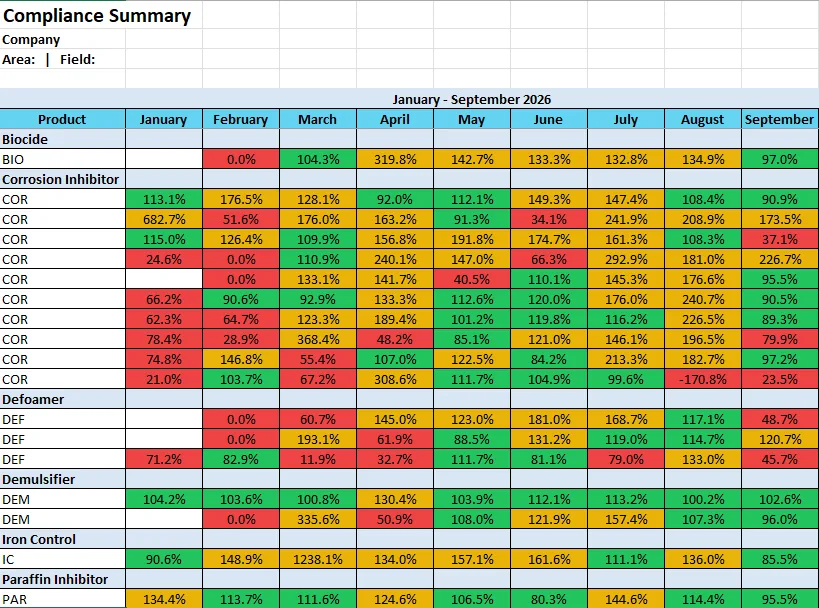
Why unit price is the wrong number
A vendor 10% cheaper per litre who runs 20% over target costs more than the expensive one who runs on target. A vendor whose corrosion program produces failures is not cheap at any price. Unit price is an input; the program is bought for outcomes. The scorecard below is the one producers on Prodesy use at renewal, and the one vendors on Prodesy volunteer to be measured on.
The four-part scorecard
| Dimension | Metric | Source | Weight (typical) |
|---|---|---|---|
| Treatment accuracy | Spend-weighted absolute variance from target; % of points within tolerance | Actuals vs target on allocated production | 35% |
| Cost per BOE | Chemical cost ÷ BOE of treated wells, by product | Invoices + production allocation | 25% |
| Outcome KPIs | Residuals above MIC, corrosion rate, bacteria counts, dewax events, H2S outlet, BS&W | Lab workflow, field events | 25% |
| Service adherence | Scheduled vs completed batches, samples, deliveries; run-outs; report timeliness | Scheduling, inventory | 15% |
Running it fairly
- Compare on the same wells or normalize by well type; a vendor on the sour, high-water-cut side of the field cannot be scored against one on sweet oil without adjustment.
- Use the producer’s production data for the denominator, not each vendor’s estimate.
- Score quarterly; share the scorecard with the vendor; agree corrective actions with dates.
- Put the scorecard in the contract as the basis for renewal and, where the vendor is willing, for performance-based pricing.
What it changes
The Canadian producer moved vendor reviews from delivery volume to treatment accuracy and eliminated $660,000 a month in cost variance. On the other side, a vendor with verified performance moved its contracts to outcome-based terms and kept the accounts. Benchmarking is not adversarial when both sides see the same numbers.
Frequently asked questions
Can we benchmark with a single vendor?
Yes: against target and against the vendor’s own prior quarters. The scorecard is about accuracy and outcomes, not only comparison.
Will vendors accept being scored?
Good ones prefer it; it is the only way to be paid for performance rather than price. Vendors on Prodesy typically ask for the scorecard.
How much data do we need to start?
One quarter of actuals, production and lab results gives a usable first scorecard; the trend becomes meaningful after two.
Benchmark your vendors on evidence
Prodesy produces the scorecard from your data, by vendor, every quarter.
Book a demo