What Is Production Chemical Program Management?
Production chemical program management is the discipline of selecting, dosing, delivering, verifying and paying for the chemicals that keep oil and gas wells and facilities producing. This guide covers what is in a program, who runs it, how it is measured and where it goes wrong.
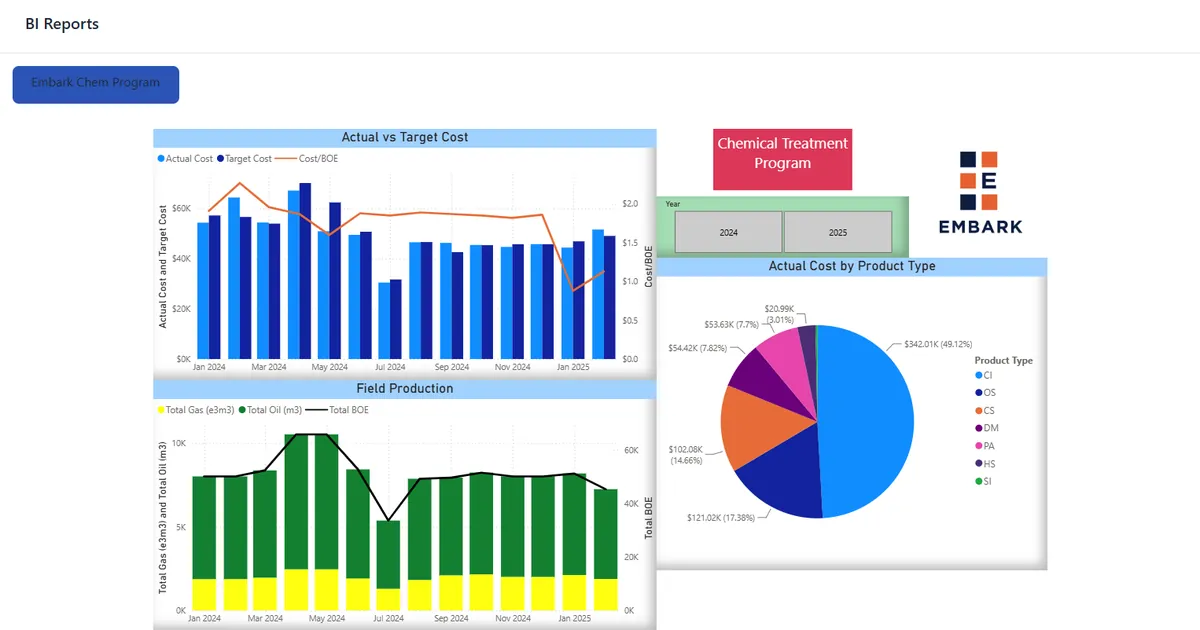
What production chemicals are
Production chemicals are the treatments applied after the well is drilled and completed to keep hydrocarbons flowing to sale on spec. The main families: paraffin inhibitors and dispersants, corrosion inhibitors, scale inhibitors, H2S scavengers, biocides, demulsifiers, plus foamers, defoamers, oxygen scavengers and drag reducers depending on the asset. Together they are commonly the largest controllable operating cost after power and labour.
How chemicals are applied
- Continuous injection from a tank through a chemical pump at the wellhead, into the flowline or at the facility, targeted in PPM of the fluid treated.
- Batch treatment down the casing annulus or into a pipeline on a schedule, targeted in volume and frequency.
- Squeeze treatment into the formation for scale or corrosion inhibitors, targeted in squeeze life.
- Capillary injection downhole for gas wells and specific chemistries.
The program: what has to be managed
| Element | What it means | Where it usually lives |
|---|---|---|
| Targets | PPM or volume per injection point, set by the engineer or the vendor | Vendor spreadsheet |
| Actuals | Pump rate, tank-level change or telemetry | Field ticket |
| Production | Fluid volume treated per point, needed to calculate PPM | Accounting system |
| Inventory | Tank levels, deliveries, run-out | Vendor and truck |
| Lab results | Residuals, bacteria, corrosion, water chemistry | PDF reports |
| Cost | Invoices by product and site | AP system |
Program management is bringing those six into one view. That is what chemical program management software exists to do.
Roles
On the producer side: the chemical manager or chemical coordinator, production engineers who set targets and integrity engineers who consume lab results. On the vendor side: the account or district manager, field techs who deliver and read tanks, and lab staff. In most programs the vendor holds the data and the producer holds the invoice, which is the root of most of the problems below.
KPIs that matter
- Treatment accuracy / compliance: actual PPM over target, per point. See the variance guide.
- Cost per BOE by product, program and vendor. See the cost per BOE guide.
- Outcome KPIs: residuals above MIC, corrosion rate, bacteria counts, H2S outlet, dewax frequency, BS&W.
- Service adherence: scheduled vs completed batches, samples and deliveries.
- Inventory health: run-outs and emergency deliveries.
Where programs fail
Targets set once and never revisited as production declines. PPM calculated on stale production estimates. Lab results filed rather than trended. Vendors reporting on themselves. Chemical staff spending the month consolidating spreadsheets rather than managing the program. Industry-typical treatment variance of 15–20% is the sum of these; programs that fix them run under 5%. Compare spreadsheets vs software.
Frequently asked questions
What is the difference between production chemicals and drilling or completion chemicals?
Production chemicals are applied to producing wells and facilities for the life of the asset; drilling and completion chemicals are used during construction and stimulation. Program management here refers to production chemicals.
Who should own the chemical program, producer or vendor?
The producer owns the targets, the data and the outcomes; the vendor executes and advises. The most effective programs give both parties the same data.
How large is a typical program?
From a few dozen injection points on a small conventional asset to thousands across a large unconventional operator with several vendors.
See a managed program in Prodesy
A 30-minute demo using your own injection points and vendors.
Book a demo